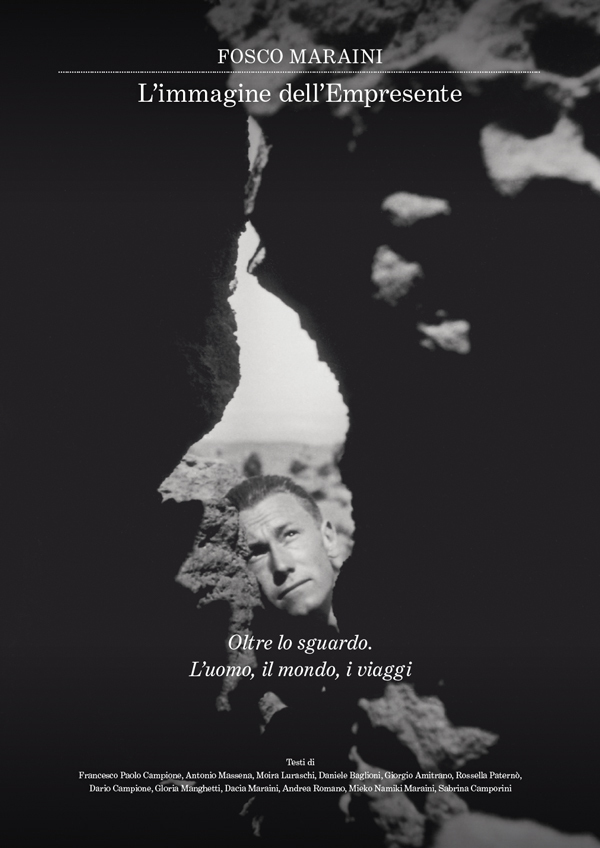
Fosco Maraini, one of the most fascinating and multifaceted figures of the 20th century, continues to represent a vital bridge between the West and the East. His life was a ceaseless exploration that put the soul before the land, with an approach that combined scientific rigour, artistic sensitivity and a deep-rooted belief in the value of connection.
Born in Florence in 1912 into a cosmopolitan family, Maraini made the world his home. In 1937, together with the orientalist Giuseppe Tucci, he set off on a five-month expedition to Tibet and, later that year, he and his family moved to Japan, a country that would become his second home and the main focus of his studies. It is where he carried out extraordinary research into the Ainu people of Hokkaido, documenting rituals and traditions on the verge of dying out through text and photographs.
His life was also marked by some extremely difficult times: in the aftermath of the events of 8 September 1943, Maraini’s refusal to swear allegiance to the Italian Social Republic led to his internment in a Japanese prison camp along with his wife, Topazia Alliata, and their children Dacia, Yuki and Toni, until 15 August 1945.
After the war, his activities branched out in many different directions. He took part in a series of historic expeditions, again alongside Giuseppe Tucci, and produced some outstanding accounts such as Segreto Tibet (Secret Tibet), a work published in 1951 that blends social analysis with epic storytelling. As a mountaineer, Maraini took part in the successful national expedition to Gasherbrum IV (an iconic mountain in the Karakoram, straddling the border between China and Pakistan) in 1958, overseeing not only the ascent but also the filming and photography.
He was also known for being a language innovator. Through his own vocabulary of made-up words, known as “fànfole”, and the collection Gnòsi delle fànfole (1994), he explored metasemantic poetry, in which the sound of words evokes profound meanings even in the absence of literal sense, demonstrating an intellectual playfulness that is rarely matched.
Always attentive to the evolution of Asian cultures, Maraini depicted Japan’s transition to industrial modernity in works such as Ore Giapponesi (Meeting with Japan) (1956), which remains the gold standard for international Oriental studies to this day. His ability to capture the essence of civilisations through the lens produced an invaluable archive which, thanks to the dedication of his daughters Dacia and Toni, his granddaughter Yoï and his second wife Mieko Namiki (whom he married in 1970), is now preserved and curated by the Gabinetto Vieusseux in Florence.
Fosco Maraini received a host of prestigious international awards and was a lecturer in Japanese language and literature at the University of Florence (1972). He passed away in 2004, leaving behind a legacy of observing the world through a lens of wonder, respect and a deep understanding of human diversity.
You can contact our call centre between 8 a.m. and 5.30 p.m. Monday to Friday on 00800 800 767 76 (calls from Switzerland are free).
Alternatively, you can use our contact request forms.